
Staring at Empty shelves: a short history of how chokepoints keep walloping american retail
In December 1973, Americans started hoarding toilet paper.
The actual reason was a Wisconsin congressman who issued a press release worrying about a potential future shortage of bathroom tissue, which Johnny Carson then mentioned on The Tonight Show in front of 20 million viewers. By the next morning, supermarkets across the country had been picked clean. Stores started rationing. The St. Petersburg Times reported that of 10 grocery stores it surveyed in late December, only three were still selling toilet paper without limits.
There was no actual shortage of toilet paper. What there was was an oil embargo, a quadrupling of gasoline prices, gas station lines stretching around the block, 40% inflation in pump prices in a single month, and a country that had developed what economists at the time politely called "shortage psychology." When you're already lining up for gas, it does not take much to convince you to also line up for two-ply.
Welcome to the history of chokepoint disruption in American retail. The specific products change — toilet paper in '73, semiconductors in '21, holiday electronics in '24 — but the underlying story has been remarkably consistent for about 70 years now. Some narrow spot somewhere in the world stops working the way it's supposed to, and a few weeks or months later, somebody at a Target or a Walmart or a Costco is staring at an empty shelf wondering what happened.
So let's walk through how we got here. (Spoiler: we did this to ourselves. Repeatedly. With great enthusiasm.)
Act I: When chokepoints didn't really matter (1869–1956)
For most of the first century after the Suez Canal opened in 1869, American retail was largely insulated from chokepoint drama. The U.S. economy ran heavily on domestic manufacturing, domestic agriculture, and domestic consumption. If a canal halfway around the world closed, the average American shopper might read about it in the newspaper, then go buy a American-made washing machine from an American department store. A genuinely different world.
This is not nostalgia, by the way. There were plenty of problems with that economy. (Ask anyone who needed a part for a 1940s appliance.) But chokepoints, as a phenomenon that affected what was on the shelf at the local five-and-dime, were not really a thing.
That started to shift in 1956, when Egypt nationalized the Suez Canal and Britain, France, and Israel responded by, well, invading. The canal got blocked with sunken ships and stayed closed for about five months. American retailers barely noticed because most of what they sold still came from somewhere on this continent. A handful of importers of European goods felt some pinch. The country basically shrugged and kept shopping.
That was the last time the country got to do that.
Act II: The decade everything changed (1967–1975)
In June 1967, the Six-Day War broke out, and Egypt closed the Suez Canal again. This time, it stayed closed for eight years. (You read that correctly. Eight. Years.) The canal didn't reopen until 1975.
Eight years is long enough that global trade routes literally redrew themselves around the closure. Shipowners commissioned a new generation of supertankers — too big to fit through Suez even when it eventually reopened — designed to make the long haul around Africa economically viable. The post-1975 canal was, in some ways, less central to global trade than it had been before, simply because the world had spent a decade building infrastructure that didn't need it.
This was a quiet but profound shift, and retailers should have paid more attention. The lesson — that a closed chokepoint forces the entire global trading system to mutate, and the mutations don't always reverse when the chokepoint reopens — is one the retail industry would have to learn again. And again. And again.
While the canal was still closed, in October 1973, the second big shoe dropped: OPEC's oil embargo. Crude went from $3 a barrel to nearly $12. American gasoline prices jumped 40% in a single month. Cars lined up around the block. The economy entered the era we now call "stagflation." And then, because Americans were already nervous, the toilet paper thing happened.
The 1973 episode was the first time in modern memory that ordinary American consumers felt a chokepoint in their daily lives. Not as an abstract economic indicator. As an empty shelf. The trauma went deep enough that "shortage psychology" became a permanent, low-grade feature of American consumer behavior. (You can still see it every March, when somebody mentions a potential pandemic and the bath tissue aisle gets picked clean within 48 hours. We never really got over the original.)
Act III: The Great Optimization (198s–201s)
Here's where the story gets, frankly, embarrassing. (For the industry, I mean. Not the readers.)
Throughout the 1980s, '90s, and 2000s, the American retail industry made a series of strategic decisions that, in retrospect, look like an elaborate setup for a punchline. Sourcing moved offshore — first to Japan and South Korea, then to China at scale after WTO accession in 2001. Just-in-time inventory management, pioneered by Toyota, got religiously adopted by Walmart and then by everybody Walmart did business with. The retail inventory-to-sales ratio in the U.S. fell by 35% between 1980 and 2020. Warehouses got smaller. Backroom stockpiles got smaller. Buffer stock became a dirty word.
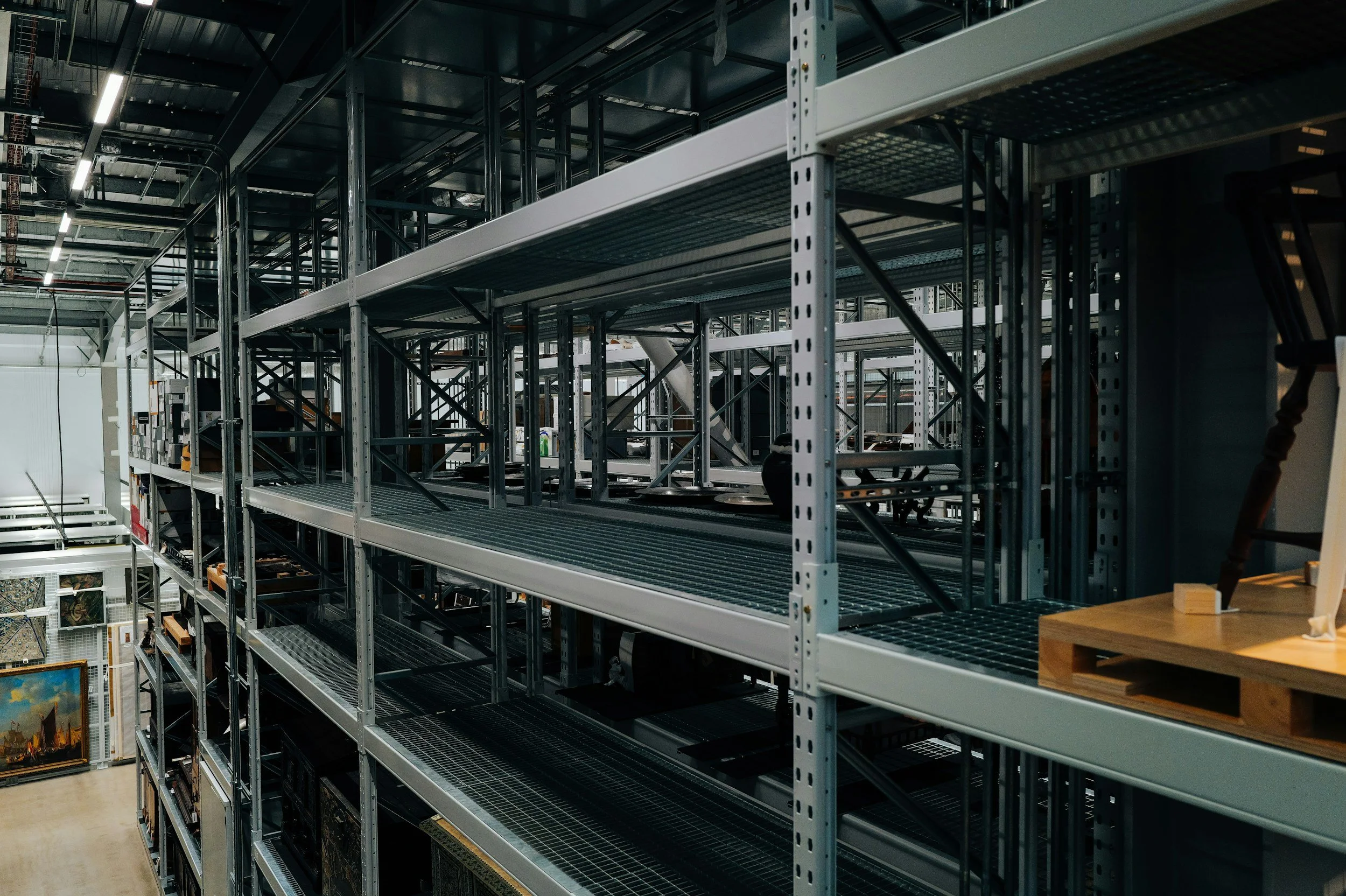
The retail inventory-to-sales ratio in the U.S. fell by 35% between 1980 and 2020. Warehouses got smaller. Backroom stockpiles got smaller. Buffer stock became a dirty word.
The logic was unimpeachable. Inventory is a cost. Carrying inventory is a tax on capital. If you can run a Target store with three days of stock instead of three weeks, you free up enormous amounts of working capital and you can pass the savings on to consumers (or to shareholders — usually shareholders). And for about 30 years, this all worked beautifully. Container ships kept getting bigger. Shipping costs kept dropping. Suez and Panama and Malacca all kept doing their boring, reliable jobs. And American shoppers got historically cheap stuff.
The downside — that the entire system was now exquisitely sensitive to the slightest disruption at any of a half-dozen geographic chokepoints — was, well, a problem for future executives. (Hi, future executives. It's now you.)
Various warning shots arrived during this period and got mostly ignored. After 9/11, U.S. air cargo was grounded for nearly a week and customs procedures slowed everything for months — costing electronics retailers dearly into the holiday season. The 2003 SARS outbreak in China led to a 15% drop in electronics exports from Guangdong province in a single quarter, briefly highlighting just how concentrated electronics manufacturing had become. The 2011 Tohoku earthquake and tsunami in Japan took out auto parts and specialty chemical supply for months, with knock-on effects in retail.
Each of these events generated some breathless trade-press coverage, prompted a few PowerPoint decks about "supply chain resilience," and was then quickly forgotten as things returned to normal. Because they always did. Until they didn't.
Act IV: The wake-up call nobody could ignore (2020)
When COVID hit in March 2020, American retail discovered, in real time and in front of a deeply unhappy customer base, what 30 years of just-in-time meant in practice.
Within weeks, factories in China were closed. Container ships were stranded. Ports were short-staffed. And then — once people stopped panicking and started shopping again, but for different things — demand patterns whipsawed in ways that no algorithm had predicted. People weren't buying office wear; they were buying home gym equipment, baking supplies, and (yes, here we go again) toilet paper. By April 2021, the U.S. retail inventory-to-sales ratio had hit 1.07 months — the lowest level in the 30 years that statistic had been tracked. Ocean freight rates from Asia surged 500% between 2020 and 2021.
Empty shelves became a recurring image of the pandemic. Patio furniture you ordered in May arrived in October. Bicycles ordered in July showed up the following spring. The Christmas 2020 shopping season was a logistical nightmare that had retailers triaging which categories to even try to keep in stock. The lessons, this time, seemed to land: virtually every major American retailer announced a "supply chain resilience" initiative. The phrase "near-shoring" entered the C-suite vocabulary. People started saying "redundancy is good, actually" without irony.
Some of those initiatives were real. Many were window dressing. Then, before anyone could finish implementing the real ones, the next thing happened.
Act V: The Greatest Hits Tour (2021–2024)
In March 2021, the Ever Given— a 400-meter container ship the size of the Empire State Building laid sideways — wedged itself across the Suez Canal for six days. About 12% of global trade passed through that canal. Approximately $10 billion in cargo was held up per day. Over 400 ships ended up queued at one end or the other.
About 20% of the containers passing through the Suez are bound for or coming from the United States. American retailers — particularly grocery, hardware, plumbing, HVAC, surgical equipment, and sporting goods — felt it within weeks. The image of one stuck boat blocking a continent's worth of trade also did something the pandemic hadn't quite managed: it made supply chain fragility legible to ordinary consumers. Suddenly everyone knew what the Suez Canal was, and that they apparently depended on it for their patio cushions.
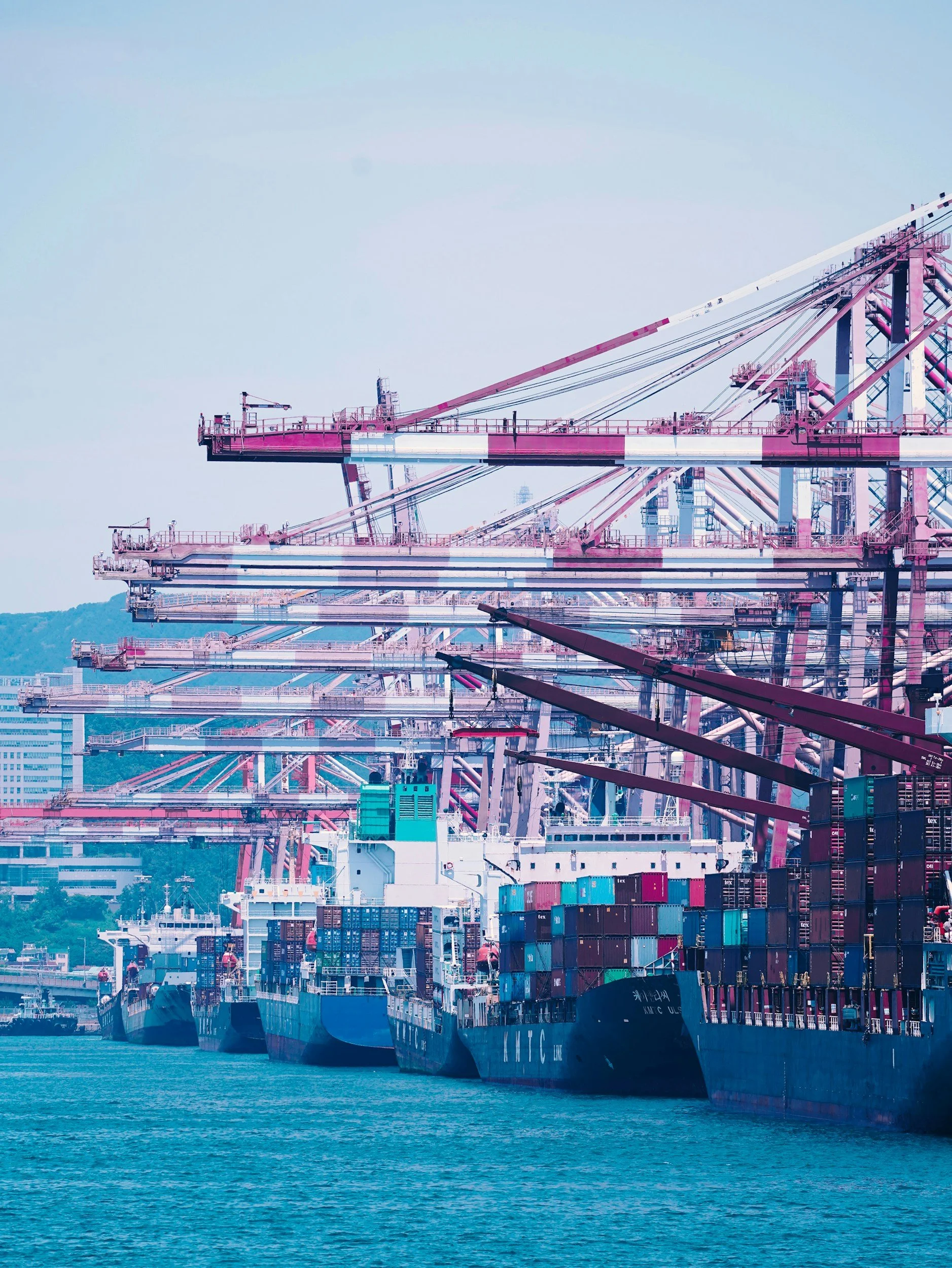
March 2021: The Ever Given
Approximately $10 billion in cargo was held up per day. Over 400 ships ended up queued at one end or the other.
Then 2021 just kept going. By November of that year, 77 container ships were stranded at anchor outside the Los Angeles and Long Beach ports. Troublesome because it’s the entry point for roughly 40% of all U.S. container imports. Almost a third of ships at dock were waiting more than five days to be unloaded. (I hope nothing on there was perishable… Oh wait, some of it was.) Photos of the ship lineup, visible from the LA hills, became the defining image of the year's holiday shopping season. Retailers from Walmart to Costco resorted to chartering their own ships — yes, individual retailers chartering their own commercial vessels, like it was 1875 — to bypass the congested ports.
In 2022, Russia invaded Ukraine and immediately disrupted Black Sea grain exports through the Turkish Straits. Wheat prices rose 55%. Every American grocery retailer had to navigate around suddenly more expensive flour, bread, breakfast cereal, and animal feed (which became more expensive meat). The geographic distance from the Bosphorus to a suburban Kroger turned out to be a lot shorter than anyone had assumed.
Don’t give up on the fun now…
In late 2023 and into 2024, two simultaneous crises hit:
Panama Canal drought. Historically low water levels in Gatun Lake — the freshwater reservoir that physically operates the canal locks — forced authorities to cut daily transits by as much as 36%. Retailers shipping from Asia to the U.S. East Coast saw delays and surcharges they hadn't planned for. Surcharges, by the way, are how shipping carriers say "we're charging you more, deal with it."
Red Sea attacks. Houthi forces in Yemen began firing missiles and drones at commercial ships in the Bab-el-Mandeb strait. Carriers rerouted around the Cape of Good Hope, adding 10–14 days and significant fuel costs to every voyage. Asia-to-Europe rates quintupled. Asia-to-U.S. rates more than doubled. American retailers absorbed the cost or passed it on. (Three guesses which one happened more often.)
The 2023–24 combination was particularly nasty because the global container fleet effectively shrank by 12% within 48 hours of the Red Sea rerouting starting — vessels were spending more time at sea per voyage, which meant fewer voyages per year, which meant less effective capacity. And capacity was the entire problem.
Act VI: 2025–2026, or "we did warn you" (current)
Which brings us to right now.
China's April 2025 rare earth export controls didn't initially feel like a retail story; magnets aren't shelved at Target. But they showed up downstream within months: in EV pricing (because every EV motor needs a magnet), in consumer electronics availability, in the cost of cordless tools, in quietly-rising prices on hundreds of categories of imported goods that nobody outside a procurement department was tracking individually. According to data from the Silverado Policy Accelerator, Chinese rare earth magnet exports to the U.S. have declined every month since October 2025.
In late February 2026, the Strait of Hormuz effectively closed following the outbreak of war between the U.S., Israel, and Iran. About a fifth of the world's oil and LNG normally moves through that strait. War-risk insurance premiums for vessels in the area went from 0.25% of hull value to as much as 5%. Pentagon officials told Congress that clearing the mines — assuming a ceasefire tomorrow, which, well — would take six months. The macro effect: oil prices up, freight costs up, fuel surcharges up, every plastic-resin-derived product on every retail shelf in the country quietly absorbing some portion of the cost.
The Red Sea is still a Houthi shooting gallery. The Panama Canal is overloaded by the rerouted traffic. Slot auction prices at Panama have gotten so absurd that one company recently paid $4 million to jump the queue, per the Panama Canal Authority. ($4 million. To skip a line. That cost goes somewhere. Specifically: into your shopping cart.)
The 2026 holiday season is going to be interesting. ("Interesting," in retail planning circles, is generally a euphemism for "we hope nobody gets fired.")
The pattern American retail keeps refusing to fully internalize
If you zoom out across 70 years of this stuff, a few things stand out about the retail experience specifically.
Retailers feel chokepoints last and most visibly.
Manufacturers feel disruption when components don't arrive. Wholesalers feel it when shipments are delayed. Retailers feel it when a customer walks up to a shelf and the thing isn't there. And when the customer decides whether to keep shopping at this retailer or go to a competitor based on whether the thing was there. Empty shelves are an existential brand problem in a way that delayed components are not.
Holiday timing is brutal and unforgiving.
A six-day Suez blockage in March is recoverable. The same six-day blockage in October would obliterate the holiday season for product categories ordered months in advance. Retail operates on a calendar that does not negotiate. You cannot tell consumers to celebrate Christmas in February because the boats were late. (Many retailers have, in fact, tried. It does not work. Grinch.)
Consumers transmit shocks faster than supply chains can absorb them.
The 1973 toilet paper episode wasn't really about toilet paper supply. It was about consumer psychology reacting to broader chokepoint stress, and a media ecosystem that amplified the panic. The 2020 toilet paper episode was the same story in different clothes. The next one will probably also involve toilet paper, honestly. We have a thing about toilet paper. Also, we’re sheep.
The "lessons learned" cycle is real and short.
Every disruption since at least 1973 has produced solemn industry promises to diversify sourcing, build buffer inventory, and reduce single-points-of-failure. Some of those promises get kept. Most quietly fade as the urgency does. Three years after Ever Given, plenty of retailers were back to optimizing for cost rather than resilience. Until the next thing. Then the cycle restarts.
Where this leaves the industry
The honest assessment in 2026 is that American retail is significantly better prepared for chokepoint disruption than it was in 2020 — and still nowhere near as prepared as it should be.
Most major retailers now have multi-source supplier strategies, dedicated supply chain risk teams, and AI-driven scenario modeling running constantly in the background. Many have brought meaningful production back to Mexico under nearshoring strategies that are finally yielding actual factory openings rather than press releases about future factory openings. Inventory-to-sales ratios are higher than they were before COVID, deliberately so, even if it costs working capital efficiency.
But the underlying geography hasn't changed. Hormuz is still narrow. Suez is still narrow. Panama still depends on rainfall. Bab-el-Mandeb is still a Houthi shooting range. Taiwan is still where the chips come from. The infrastructure that the modern retail supply chain depends on is the same infrastructure that wars, droughts, and stuck container ships have been disrupting for decades. The lesson of 70 years of this is that something somewhere is always going to go wrong, on a timeline nobody picked, in a way that wasn't quite forecast, and the customer is still going to walk up to a shelf expecting the thing to be there.
So American retail keeps doing what American retail has done since the toilet paper panic of 1973: improvising, absorbing, passing through what it can, eating what it can't, and hoping that whatever the next chokepoint event is, it doesn't land in October.
But maybe come and chat with Econity about it, in case we can help you mitigate risks before you run out of toilet paper.
---
Reporting and data drawn from the Federal Reserve's economic history archive, the Panama Canal Authority, the U.S. Census Bureau retail inventory series, the Silverado Policy Accelerator, the Yale Energy History project, the WTO, Snopes (yes, really), Priceonomics, the Bill of Rights Institute, ScienceDirect maritime research, Food Logistics, Labor Notes, Econity Chokepoint Database, and the 2021–2024 Quadrennial Supply Chain Review.